
Low Libido vs Erectile Dysfunction: What’s the Difference?

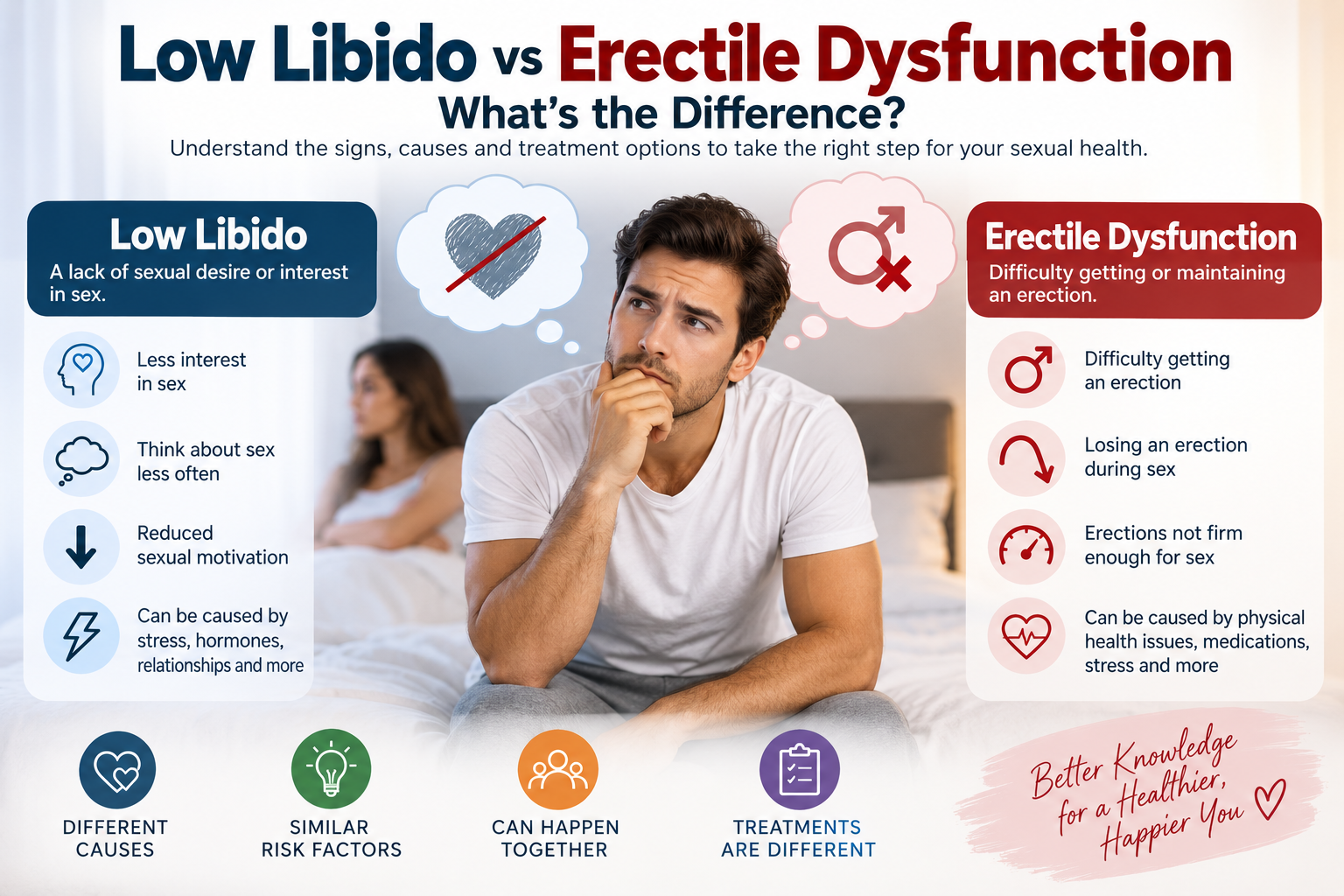
Here’s a mix-up that happens all the time: a man assumes he has one problem when he’s actually dealing with another entirely. Low libido vs erectile dysfunction is exactly that kind of confusion — both can derail a man’s sex life, but they’re not the same thing at all, and treating them as interchangeable usually means chasing the wrong fix.
Low libido, at its core, is about desire. You’re just not that into sex lately, or not nearly as often as you used to be.
Erectile dysfunction (ED) is a whole different situation — it’s really about erection function. You might want sex just as badly as ever, but your body isn’t cooperating when it counts.
Sometimes these show up alone. Sometimes they show up together and tangle into each other. Either way, figuring out which one you’re actually facing is where everything else starts.
What Is Low Libido?
Put simply, low libido means your interest in sex has dipped below wherever your normal used to sit.
There’s no universal baseline here, so don’t go comparing yourself to some imaginary average. Desire moves around naturally with age, stress, sleep, relationships, hormones, medications — basically your whole life circumstances.
Our recent guide, What Is Libido? Why It Changes and How to Support a Healthy Sex Drive, gets into more detail on how desire shifts across different stages of life.
A few common signs it’s dropped:
- You just don’t think about sex much anymore
- Initiating intimacy feels like effort, not something you crave
- You feel noticeably less motivated in that department
- It’s a real, noticeable change from how things used to be
- The change itself is starting to bother you
A brief dip usually isn’t a medical red flag. What actually matters is whether it lingers, or whether it’s genuinely bothering you.
What Is Erectile Dysfunction?
ED plays by a completely different set of rules.
Here, the desire is often fully intact — you want to have sex — but your body doesn’t follow through with an erection firm enough to get the job done. It’s a recognized form of sexual dysfunction, and the roots can be physical, psychological, or honestly, both at once.
Common signs look like:
- Struggling to get an erection in the first place
- Losing it midway through
- Getting one, but it’s just not firm enough
- Function that’s hit-or-miss from one time to the next
And here’s the part worth underlining: ED doesn’t mean your desire packed up and left.
You can be completely into your partner, fully in the mood, and still run into trouble with the mechanics of it.
Low Libido vs ED: The Main Difference
If you only remember one thing, remember this:
| Low Libido | Erectile Dysfunction |
| Mainly affects sexual desire | Mainly affects erection function |
| You may not feel interested in sex | You may want sex but struggle with an erection |
| Can be influenced by stress, hormones, mood, relationships, and medication | Can be influenced by blood flow, health conditions, medication, stress, and psychological factors |
| Doesn’t necessarily cause erection problems | Doesn’t necessarily reduce sexual desire |
Why does this distinction even matter? Because what you do next depends entirely on which one you’re actually up against.
Low desire points you toward stress, sleep, hormones, medication, mental health, or relationship stuff. Persistent ED points you more toward cardiovascular health, diabetes, medications, hormones — the physical machinery side of things.
Can You Have Low Libido and ED at the Same Time?
Yeah — more often than people realize.
They overlap all the time.
Picture this: a guy starts having erectile trouble. A few frustrating experiences later, he’s anxious every time sex comes up, and eventually he stops wanting to initiate it at all. What started as ED slowly drags libido down with it.
It can flip too. Someone with very little interest in sex to start with might not get enough stimulation to build or hold an erection — so low libido ends up looking like ED from the outside.
None of this means one automatically causes the other. It just proves sexual health rarely fits into a tidy either-or box.
What Causes Low Libido?
Low desire doesn’t come from just one source — it’s usually a handful of things stacking up.
Stress and Mental Fatigue
Work deadlines, bills, family stuff, the general grind — it all eats into the mental bandwidth that intimacy actually needs.
Poor Sleep
Running on empty wrecks your mood, your energy, and honestly your interest in much of anything, sex included. Fixing sleep alone can move the needle more than people expect.
Hormonal Changes
Hormones genuinely drive desire. Testosterone shifts, in particular, can quietly chip away at libido for a lot of men.
Medications
Some medicines dial down desire or function as a side effect. Noticed a change right after starting something new? Bring it up with your doctor — don’t just quit the medication on your own.
Mental Health
Depression, anxiety, and stress that just won’t let up can all steal your interest in sex without you fully realizing why.
Relationship Factors
Distance, lingering arguments, bad communication, general tension — all of it can quietly kill desire over time.
For more practical, lifestyle-side tips, our guide on Natural Ways to Boost Libido and Stamina for Men covers exercise, sleep, food, and everyday habits worth building.
What Can Cause Erectile Dysfunction?
ED has its own separate list of usual suspects.
On the physical side:
- Diabetes
- Cardiovascular disease
- High blood pressure
- Obesity
- Hormonal issues
- Nerve-related conditions
- Certain medications
- Smoking
- Reduced blood flow
Psychological stuff plays in too — stress, anxiety, depression, relationship strain, and performance nerves can all trigger or worsen erectile problems.
And since ED can sometimes be an early flag for a bigger health issue, don’t just shrug it off as “getting older.” It’s worth actually looking into.
Can Stress Cause Both Low Libido and ED?
It can hit both, just via slightly different paths.
Stress chips away at desire by messing with mood, energy, sleep, and focus. Meanwhile, performance anxiety specifically can make it noticeably harder to get or hold an erection.
Put those together and you get a self-feeding loop that’s genuinely hard to break out of:
Stress → reduced desire or performance concerns → disappointing sexual experience → more anxiety → more sexual difficulties.
Getting out of that loop usually means tackling the stress itself, not just white-knuckling your way through the bedroom part of it.
How Are Low Libido and ED Treated?
There’s no one-size-fits-all fix, since the causes underneath can look completely different from person to person.
For low libido, treatment usually means going after the actual cause — better sleep, managing stress, revisiting your medications, working through relationship friction, or checking hormones and other health markers.
For ED, options can range from lifestyle changes and psychological support to vacuum erection devices or prescription medicines like PDE5 inhibitors, when a doctor thinks they’re the right call.
If you’re digging into ED medicines specifically, our guide Top 10 Erectile Dysfunction Medicines to Buy Online in UAE runs through some common options and what to think about before picking one.
There’s also Best ED Products in UAE: Doctor-Approved Options if you want the wider view — medication, pumps, and everything in between.
What About Tadalafil and Sildenafil?
Tadalafil and sildenafil are the two names most people have heard of when it comes to PDE5 inhibitors for ED. Their whole job is supporting the physical erection process once sexual stimulation is already happening — they’re not some kind of desire switch you flip.
Our comparison of Tadalafil vs Sildenafil covers how they differ on onset, how long they last, and food interactions.
Worth really sitting with this one: an ED medicine can fix the mechanics of an erection, but it won’t touch low desire if the real cause is stress, depression, relationship strain, or hormones. Different problem, different tool.
How Do You Know Which Problem You Have?
Ask yourself two blunt questions:
1. Do I want sex but struggle to get or keep an erection?
That’s leaning toward an erectile-function issue.
2. Do I rarely even feel like having sex to begin with?
That’s leaning toward reduced desire.
And yeah, real life is messier than a quiz — plenty of guys land on “yes” to both.
If you’re genuinely unsure, especially if it’s dragged on a while, running it by a healthcare professional can help sort out what’s actually happening under the hood.
When Should You Speak With a Healthcare Professional?
It’s worth getting real advice if:
- Your sex drive drops suddenly, out of nowhere
- ED keeps happening, not just a one-off bad night
- Sexual difficulties are genuinely bothering you
- You’ve got diabetes, heart disease, high blood pressure, or another chronic condition
- A medication seems to be messing with your sexual function
- You’re noticing other symptoms too, like fatigue or mood swings
- It’s putting real strain on your relationship or day-to-day life
Persistent ED especially can be an early sign that something bigger is going on health-wise — it’s not something to just wave off as an inconvenience.
Low Libido vs Erectile Dysfunction: FAQs
Is low libido the same as erectile dysfunction?
No. Low libido is mainly about reduced sexual desire, while erectile dysfunction is about difficulty getting or keeping an erection.
Can you have ED without low libido?
Yes. Plenty of men want sex just as much as ever but still struggle to get or maintain an erection.
Can low libido cause erectile dysfunction?
Not necessarily. They’re separate conditions, though they can show up together and feed into each other.
Can stress cause low libido and ED?
It can contribute to both — draining desire and making erections harder to maintain. Performance anxiety specifically tends to make ED worse.
Do Viagra or tadalafil increase libido?
Not really. They’re built to support erectile function, not spark desire that’s low for some other reason entirely.
Is low libido normal with age?
Desire does shift with age, sure, but a persistent or upsetting change shouldn’t just get filed under “getting older.” Hormones, health, medication, relationships, and lifestyle all play a part.
Can lifestyle changes help?
Good sleep, regular movement, decent nutrition, managing stress, and cutting back on smoking or heavy drinking can all support things. Still, the right fix depends on what’s actually behind the problem.
Final Thoughts
At the end of the day, low libido vs erectile dysfunction comes down to one simple idea: desire and erection function are two completely different things.
You can want sex badly and still struggle to get an erection. You can also have zero trouble physically and just not feel like it. And sometimes, both show up at once, tangled together.
Once you know which one you’re actually dealing with, you stop wasting time on a fix that was never going to touch the real problem. If it’s sticking around, genuinely bothering you, or showing up alongside other health changes, talking to a professional is the smart next move — not a last resort.
For a general reference, Wikipedia’s Erectile Dysfunction article has more background on the condition.